


++Photo & caption info embargoed until 05.00am BST, 01st October 2020++
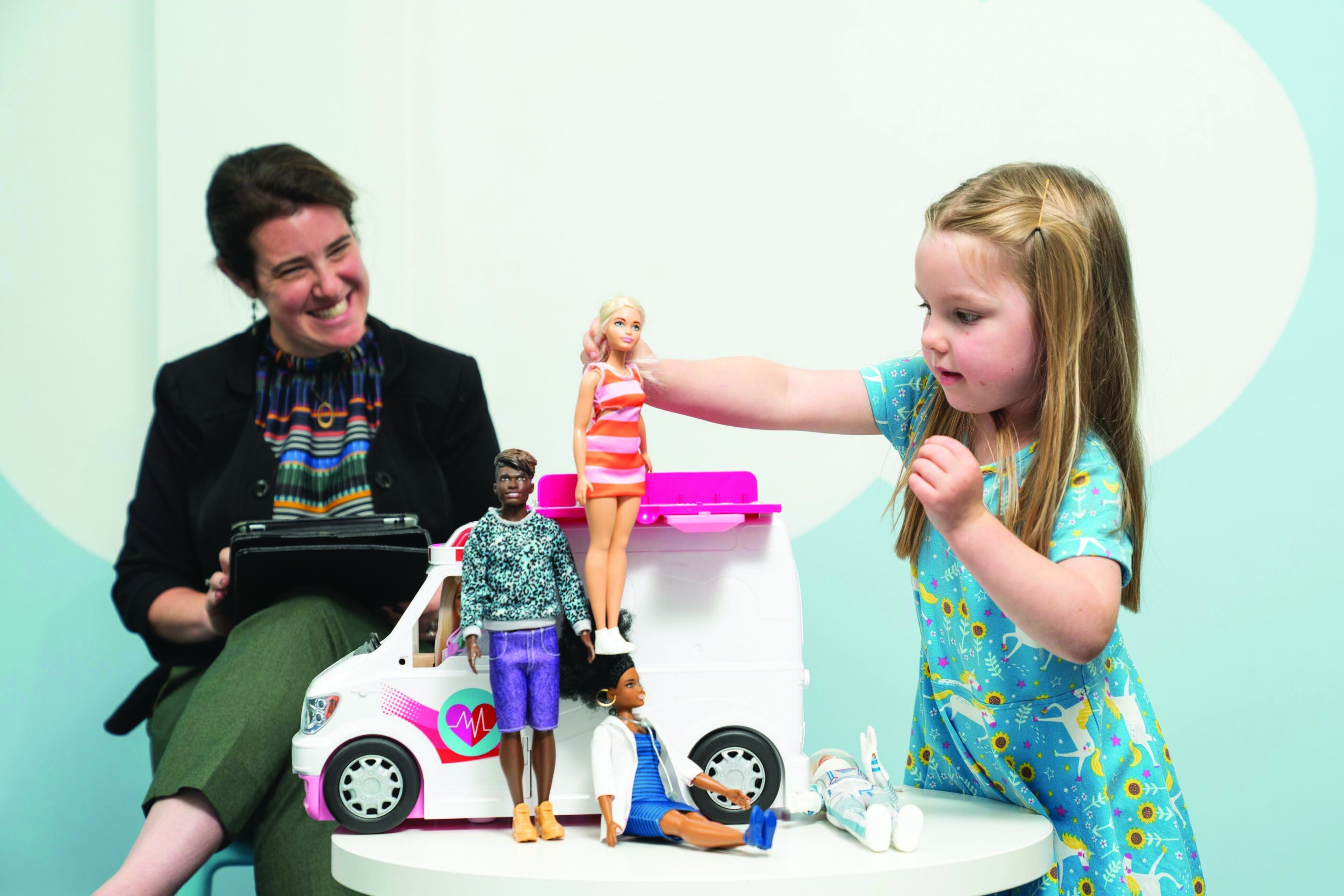
Photograph was taken at a scientific lab at Cardiff University’s Centre for Human Developmental Science and shows Dr. Sarah Gerson, with Phoebe, age 4, who lives in Caerphilly in Wales alongside her Mum, Charlotte, a solicitor. Phoebe was one of the children who took part in the first neuroscience study of the positive impact of doll play. The study by Cardiff University neuroscientists in partnership with Mattel, the makers of leading doll brand Barbie, is the first-time neuroimaging data has been used to highlight how the brain is activated during natural play with dolls. It brought to light new evidence that doll play activates brain regions that allow children to develop empathy and social information processing skills, even when playing by themselves. Over the past 18 months, senior lecturer Dr. Sarah Gerson and colleagues at Cardiff University’s Centre for Human Developmental Science have used an emerging neuroimaging technology, functional near-infrared spectroscopy (fNIRS), which makes it possible to scan brain activity while the subject is freely moving around, to provide the first indications of the benefits of doll play at a brain level. Through monitoring the brain activity of 33 children between the ages of 4 and 8, as they played with a range of Barbie dolls, the team found that the posterior superior temporal sulcus (pSTS), a region of the brain associated with social information processing such as empathy, was activated even when the child was playing on their own. These benefits of solo doll play were shown to be equal for both boys and girls and are likely to be country agnostic. The peer-reviewed paper for the study will be published in ‘Frontiers in Human Neuroscience’ on 01st October 2020. Image copyright Mattel, Inc. Press contact: Mark Collins at MCPR, +44 (0)797421534 / markc@markcollinspr.com